Innovator
When Floodwater Is Everywhere, But Drinking Water Isn’t: How a Professor’s Innovation Is Helping Flood-Hit Assam
When Prof. Harjeet Nath began working on water purification at Tripura University, he was not developing a machine specifically for a future flood in Assam. He was working on a problem he had been interested in for years: how to make safe drinking water available in places where conventional water infrastructure is limited or unavailable.
Nath, an Assistant Professor in Tripura University's Department of Chemical and Polymer Engineering, works in areas including water disinfection, wastewater treatment, membranes and product development. His interest in practical solutions for communities eventually led him towards portable water purification.
The idea began taking shape around 2018–19. In 2019, he developed a suitcase-sized water purification system capable of treating water from different sources. The system was designed to be portable and operate using electricity or solar power, making it particularly useful for remote areas and emergency situations such as floods. Tripura University's records also document a demonstration of his portable purifier in a village in November 2019.
The invention was subsequently developed further with institutional support. The project received ₹12.75 lakh in grant support through the MSME Business Incubation programme, with a total project cost of ₹16 lakh during 2021–23. It also received ₹4 lakh through AICTE YUKTI 2.0 during 2022–23. The original patent for the Water Purification System was granted in July 2023.
The technology eventually moved out of the laboratory and into actual disaster situations.
During the 2022 floods in Silchar, Assam, Tripura University sent a relief team equipped with the portable purifier. The machine was used to produce drinking water for people affected by the floods.
It was tested again during the severe 2024 Tripura floods, when Nath used the purifier at a relief camp in Gomati district. Around 5,000 litres of purified water were supplied in two days.
And now, as floods once again affect Assam, the same line of innovation has found another application.
The immediate problem after a flood is not simply the absence of water. There may be water everywhere — but very little of it may be safe to drink.
Floodwater can contaminate wells, ponds and community water sources with sewage, waste and other pollutants. That can increase the risk of water-borne diseases. For families cut off from normal supplies, obtaining safe drinking water becomes an essential part of relief operations.
This is where a machine conceived years earlier inside a university laboratory becomes particularly relevant.
Through HN Technovations LLP, the university-linked startup founded by Nath, the technology has evolved into portable, field-deployable water purification systems. During flood relief operations in Assam, the team has worked with local authorities to produce purified water close to affected communities. In one reported operation in Cachar, the system supplied approximately 2,000 litres of purified water a day to flood-affected people.
There is something significant about this journey. The machine was not invented when Assam flooded. The flood simply created the situation in which an existing innovation became immediately useful.
An idea that began with a professor's interest in solving a real-world problem, received support to move beyond experimentation, and was subsequently refined through field experience is now being used where one of life's most basic requirements — safe drinking water — becomes difficult to obtain.
And that perhaps is one of the most practical measures of innovation: **not how impressive a machine looks in a laboratory, but whether it can solve a problem when people actually need it.**
App maker at just 14
What were you doing at 14?
Scrolling through reels? Worrying about exams? Or wondering what to do over the weekend?
Now imagine building an AI platform that helps thousands of people make informed decisions before casting their vote.
That's exactly what a young student did with Nee Yosi—a name that translates to "You Think." The platform wasn't designed to influence voters or push a political agenda. Instead, it aimed to do something much more powerful: encourage people to think before they vote.
Built by Chennai-based student Kapil Bhaskar, Nee Yosi used artificial intelligence to simplify publicly available election data. It gathered information about thousands of candidates and presented it in a clear, easy-to-understand format in both Tamil and English. Instead of making users read lengthy election affidavits, the platform highlighted essential details such as educational qualifications, declared assets, criminal cases, and other key information.
The idea was refreshingly simple. Democracy becomes stronger when citizens are informed. Rather than telling people who to vote for, Nee Yosi empowered them to ask better questions and make their own choices.
What's even more inspiring is that the project was built with limited resources. Using AI and publicly available data, the platform reached tens of thousands of users during the election period, proving that meaningful innovation doesn't always require massive funding or a large team. Sometimes, it begins with one curious mind asking, "How can I solve a real problem?"
Stories like these remind us that technology is only as powerful as the purpose behind it. While many of us use AI to save time or create content, a teenager used it to strengthen civic awareness.
Perhaps that's the real takeaway.
The future doesn't belong only to those who build bigger technologies. It belongs to those who build technologies that make people think.
And maybe the next groundbreaking idea isn't waiting inside a billion-dollar company.
Maybe it's waiting inside the mind of a curious teenager who simply chooses to ask, "How can I make life a little better for others?"
Atharva Chaturvedi
Jul 2026
Biggest battles are won by those who refuse give up.
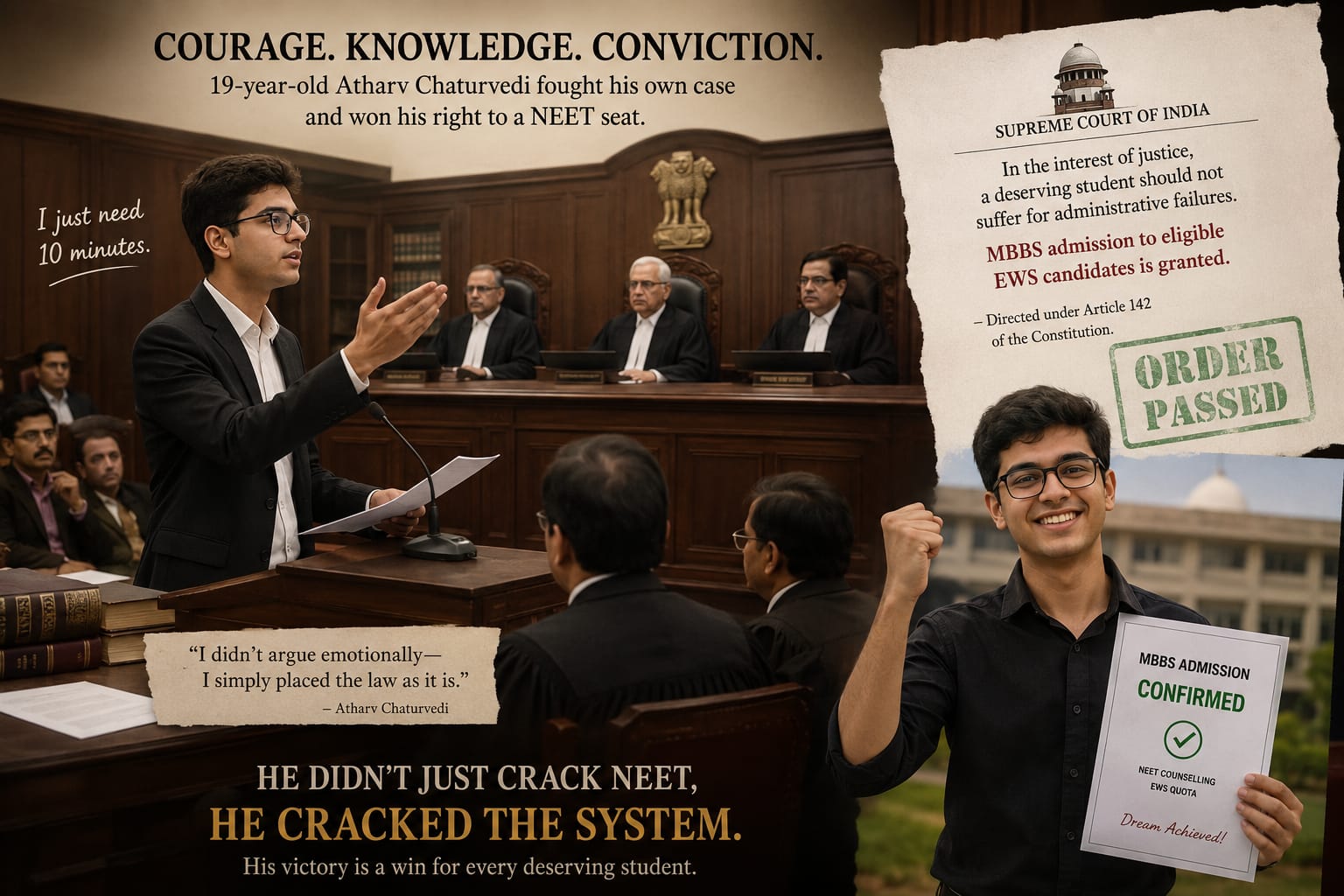
Here's the inspiring story of Atharva Chaturvedi, the 19-year-old NEET aspirant from Jabalpur, Madhya Pradesh, who refused to let a policy gap end his dream of becoming a doctor.
When Atharva cleared NEET with 530 marks under the Economically Weaker Section (EWS) category, he believed he had earned his chance to study medicine. But during counselling, he discovered that private medical colleges in Madhya Pradesh had not properly implemented the constitutionally mandated 10% EWS reservation. As a result, despite qualifying, he was denied an MBBS seat.
Many students would have accepted defeat. Atharva chose a different path.
Without any formal legal training, he immersed himself in the Constitution, read court judgments, studied previous cases, and learned how court proceedings worked. Instead of hiring a senior advocate, he decided to argue his own case before the Madhya Pradesh High Court—and later before the Supreme Court of India.
Standing in a courtroom filled with experienced lawyers, the 19-year-old presented his arguments based on the 103rd Constitutional Amendment and Articles 15(6) and 16(6), which provide for EWS reservation. He argued that eligible students should not be punished because the state had failed to implement the law properly.
One of the most memorable moments came in the Supreme Court. As the judges were about to conclude the hearing, Atharva respectfully requested, "I just need 10 minutes." Those ten minutes became the turning point of his journey. �
www.ndtv.com +1
The Supreme Court agreed that a deserving student should not suffer because of administrative failures. Invoking its extraordinary powers under Article 142 of the Constitution, the Court directed the authorities to grant provisional MBBS admission to eligible EWS candidates, including Atharva. His dream of becoming a doctor was finally restored.
Atharva later said, "I didn't argue emotionally—I simply placed the law as it is." That single sentence captures the essence of his remarkable journey.
His story is not merely about winning a court case. It is about determination, self-belief, and the courage to stand up for one's rights. He proved that age, lack of legal experience, and overwhelming odds matter less than preparation, conviction, and persistence.
Sometimes, the biggest battles in life are not won by the strongest or the most powerful, but by those who refuse to give up when the system tells them "No." Atharva Chaturvedi's journey reminds us that knowing your rights—and having the courage to defend them—can change your own life and pave the way for many others.
The Man Who Built a Forest
In 1979, a 16-year-old boy from Assam walked along a barren sandbar on the mighty Brahmaputra River. What he saw disturbed him deeply—hundreds of snakes had died because there were no trees to protect them from the scorching sun.
Most people would have moved on, but Jadav Payeng decided to do something.
He planted a few bamboo saplings. Then he returned the next day. And the day after that. What started as a handful of plants became a daily mission. For more than 40 years, he planted and cared for trees almost every single day.
The result?
A forest covering over 1,300 acres—larger than many city parks—now flourishes where there was once only barren land. The forest, often called Molai Forest, is home to elephants, deer, rhinoceroses, monkeys, countless birds, and even tigers.
Jadav never waited for permission. He didn't have a large organization, huge funding, or a social media campaign. He simply believed that one person, taking one small action every day, could make a difference.
And he was right.
Today, he is known around the world as the "Forest Man of India." His work reminds us that meaningful change rarely happens overnight. It grows through patience, consistency, and the courage to begin.
We often think we need grand resources to create change. Jadav Payeng proves otherwise. A single act, repeated consistently over years, can transform not just a landscape—but generations.
"Great achievements are rarely the result of one giant leap—they are built through thousands of small steps taken with unwavering commitment."
Brazil initiates positive change
Jul 2026
The coolest libraries of Brazil
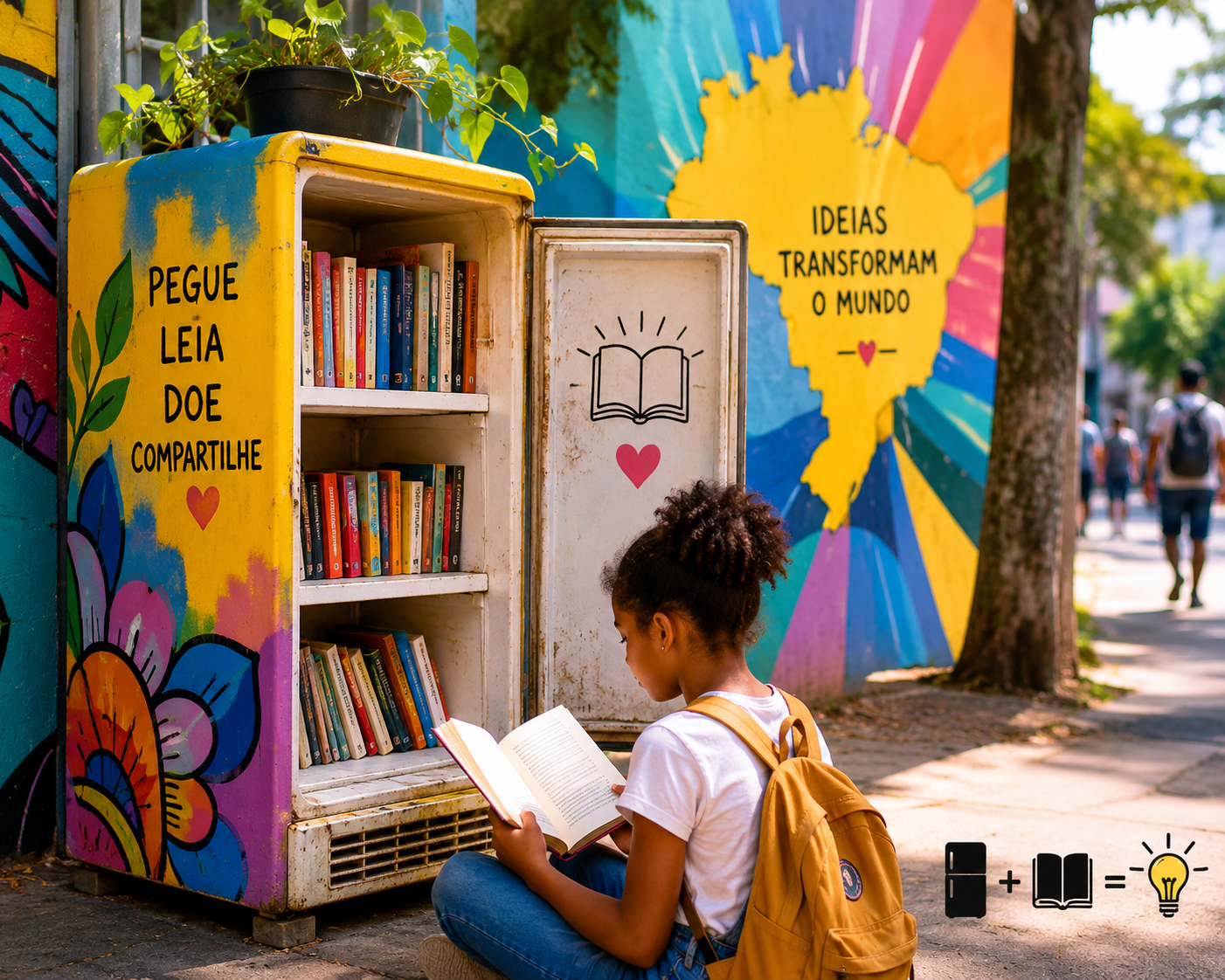
Imagine walking down a street in Brazil, opening the door of an old refrigerator, and instead of finding food, discovering shelves filled with books.
That is the simple yet powerful idea behind community initiatives such as Geloteca and Refresque Ideias. Across several Brazilian cities, discarded refrigerators that would otherwise end up in scrapyards are cleaned, painted with vibrant graffiti, and transformed into free roadside libraries.
The concept is beautifully simple: Take a book. Read it. Return it—or leave another one for someone else. There are no membership cards, no fees, and no paperwork. The libraries operate entirely on trust, making books accessible to anyone who passes by.
What makes these "fridge libraries" special is that they solve two problems at once. They give a second life to old refrigerators, reducing waste, while also nurturing a culture of reading in neighbourhoods where access to books may be limited. Many of these colourful refrigerators are installed in parks, public squares, train stations, and community spaces, turning ordinary street corners into places of learning and connection.
The initiative is more than a recycling project—it is a reminder that knowledge should never be locked away. With a little creativity, an appliance that once kept food fresh now keeps ideas alive.
Sometimes, the biggest social innovations don't require cutting-edge technology. They begin with an old refrigerator, a few donated books, and a community that believes reading can change lives.
Story of 5 friends
Jun 2026
Change Makers
Most of us see a problem and hope someone else will solve it. A few complain about it. But every once in a while, a handful of ordinary people decide to become the "someone" they have been waiting for.
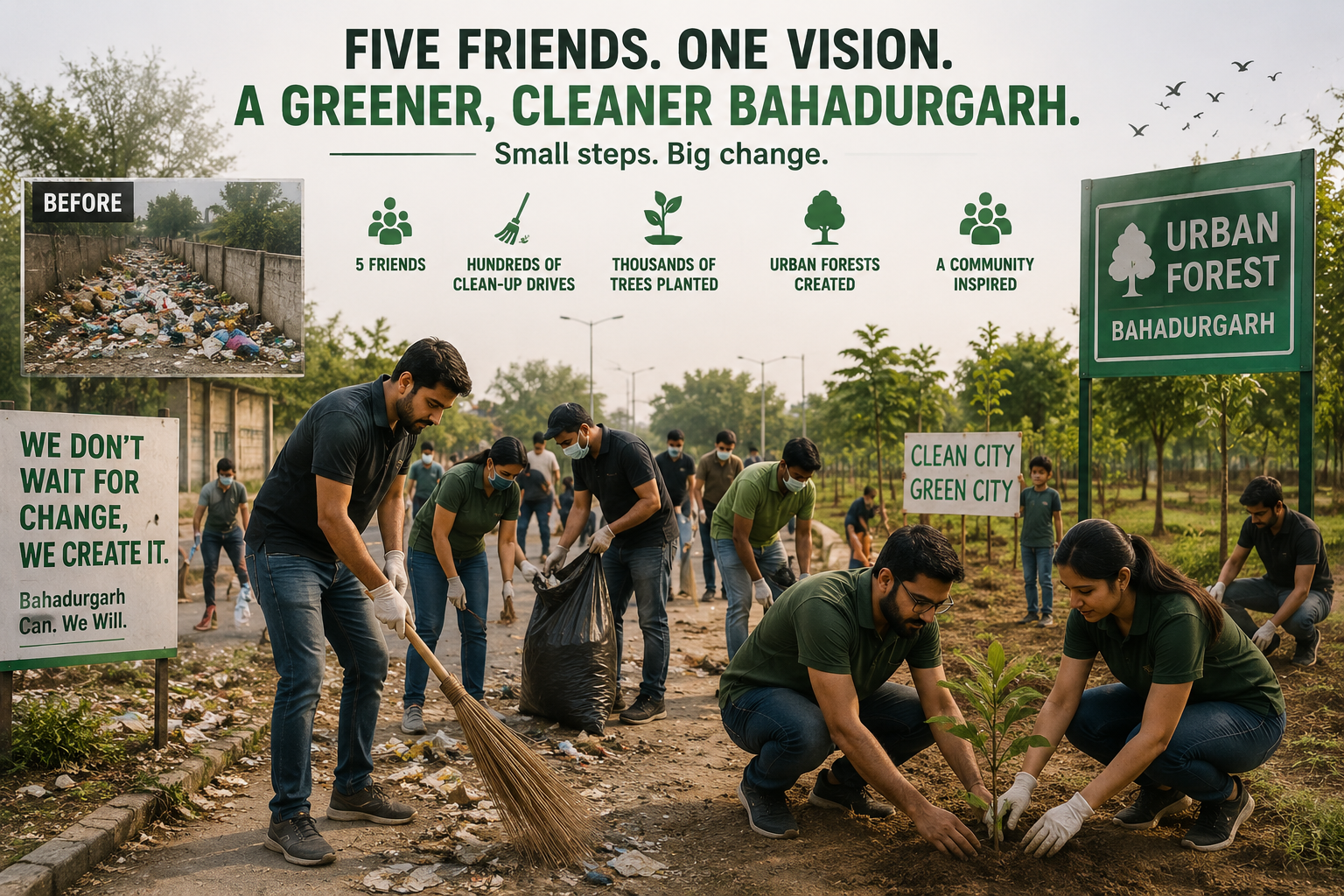
Ten years ago, five friends in Bahadurgarh, Haryana, grew tired of seeing their surroundings neglected. Instead of waiting for change, they picked up brooms and started cleaning public spaces themselves. Many dismissed their efforts. Some laughed. Others said it wouldn't last.
But they kept showing up—week after week, year after year.
What began as a simple act of responsibility slowly became a community movement. Volunteers joined in. Children participated. Waste-filled corners turned into green spaces. Their journey eventually led to hundreds of cleanliness drives, thousands of trees being planted, and the creation of urban forests that continue to breathe life into the city.
Their story is a reminder that change rarely begins with power, money, or authority. It begins with a few people who care enough to take the first step. Sometimes, all it takes to transform a place is the courage to stop waiting and start doing.
Sustainable Innovator
Stories of people making the world a little better than they found it.
Standing at a cremation ground after the loss of his father, Limaye found himself wondering how many trees were being cut every day to fuel funeral pyres. In a country where millions are cremated annually, the numbers were staggering. Was there a way to honour tradition without costing the earth?
Rather than dismissing the thought, he followed it.
The Nagpur-based environmentalist spent years studying cremation practices and experimenting with alternatives. What eventually emerged was Mokshkastha—briquettes made from agricultural waste such as crop residue that farmers often burn after harvest. These compressed blocks could perform the same function as firewood during cremation while reducing the need to fell trees.
The beauty of the idea lies not just in what it replaces, but in what it connects. Crop waste that once contributed to pollution is given a meaningful second life. Farmers gain an additional source of income. Thousands of trees are spared. And families can continue performing last rites in a manner that respects both tradition and nature.
Change does not always arrive through grand speeches or revolutionary technology. Sometimes it begins with a quiet moment of reflection and a simple question: Can this be done differently?
Vijay Limaye's story reminds us that sustainability is not about abandoning our traditions. It is about reimagining them for a world that needs our care more than ever.